
A Dulatect purchase requires more than matching a brand name to a quoted price. You need to confirm the anidulafungin presentation, clinical fit, preparation and storage requirements, legal supply route, and the documents that prove the vial was manufactured and released correctly.
Key takeaways
- Confirm candidiasis and the destination label before ordering anidulafungin.
- Compare dosing, reconstitution, infusion time, and storage with caspofungin and micafungin.
- Request the package insert, batch documents, licence details, and temperature records.
- Choose direct supply, distribution, or third-party manufacturing according to volume and control needs.
When anidulafungin is the right purchase—and how the 100 mg vial is used
Confirm the infection, adult regimen, and presentation before ordering Dulatect. Anidulafungin is an intravenous echinocandin for candidemia and other invasive Candida infections, and for esophageal candidiasis when the destination country’s label includes that indication. “Antifungal” does not make it a default treatment for invasive aspergillosis or other mould infections.
- For candidemia or another invasive Candida infection, use the usual adult regimen: 200 mg intravenously on day 1, followed by 100 mg once daily.
- For esophageal candidiasis, use 100 mg intravenously on day 1, followed by 50 mg once daily.
- A 100 mg vial supplies one 100 mg maintenance dose. A 200 mg loading dose requires two 100 mg vials unless the approved product is supplied in another strength.
Before accepting a quotation, ask the anidulafungin injection manufacturer or supplier to confirm that Dulatect contains anidulafungin and matches the destination country’s medicines register for strength, lyophilized injection dosage form, registration number, and labelled manufacturer. Export eligibility alone does not prove local registration.
Renal impairment, haemodialysis, and hepatic impairment do not usually require anidulafungin dose adjustment. That does not replace clinical assessment of the patient, organism susceptibility, drug interactions, or infusion reactions. Do not substitute fluconazole, liposomal amphotericin B, or another echinocandin solely because each is an antifungal injection.
How Dulatect compares with caspofungin and micafungin
Compare all three echinocandins before approving an anidulafungin injection. Their schedules, preparation time, liver considerations, and interaction profiles affect both patient care and pharmacy workload.
| Agent | Dose and schedule | Vials, preparation, and key cautions |
|---|---|---|
| Anidulafungin | Adults: 200 mg loading dose, then 100 mg once daily for invasive Candida; 100 mg, then 50 mg daily for oesophageal candidiasis | Usually 100 mg vials; reconstitute with sterile water, dilute in approved sodium chloride or dextrose, and infuse at no more than 1.1 mg/min. No routine renal, haemodialysis, or hepatic adjustment. |
| Caspofungin | 70 mg loading dose, then 50 mg daily; 70 mg daily for selected indications or patients | 50 mg and 70 mg vials; prepare only with labelled diluent instructions and infuse over about one hour. Reduce maintenance dosing in moderate hepatic impairment; review rifampicin, phenytoin, carbamazepine, dexamethasone, and other enzyme inducers. |
| Micafungin | 100 mg daily for candidemia; 150 mg daily for oesophageal candidiasis; paediatric dosing is weight- and indication-specific | 50 mg and 100 mg vials; reconstitute and dilute per label, usually for infusion over one hour. No routine renal adjustment; check hepatic guidance and interactions involving sirolimus, nifedipine, and itraconazole. |
Anidulafungin’s renal profile can suit a hospital managing acute kidney injury, but susceptibility, liver status, and infusion reactions still require review. Check the formulary agent, adult and paediatric indications, Candida patterns, ICU protocols, approved diluent stock, and compounding workload.
Do not compare it as interchangeable with fluconazole, liposomal amphotericin B, or another echinocandin. For an antifungal injection manufacturer and marketer dulatect search, apply this test: choose the product whose approved indications, schedule, continuity, compatibility instructions, and total preparation burden fit your patients and formulary.
What the package insert must say about preparation, infusion, and storage
A pharmacy should reject a preparation instruction copied from a generic website. The current, country-specific package insert must identify sterile water for injection, the final concentration, approved secondary diluents such as 0.9% sodium chloride or 5% dextrose, line requirements, and a maximum infusion rate commonly about 1.1 mg per minute.
The preparation sequence must be explicit:
- Add the stated volume of sterile water for injection to the lyophilized vial.
- Gently dissolve the powder; do not shake if the insert prohibits vigorous agitation.
- Withdraw the reconstituted solution and dilute it only in the listed secondary diluent and volume.
- Administer by intravenous infusion through the specified line, filter, or dedicated access.
Anidulafungin is not for IV bolus or rapid push. Confirm compatibility before using calcium-containing solutions, Y-site administration, or any admixture absent from the insert.
The buyer should obtain these limits in writing:
| Parameter | What the insert must state |
|---|---|
| Unopened vial | Temperature range, light protection, and permitted excursion range |
| Reconstituted solution | Maximum in-use time and storage temperature |
| Diluted solution | Stability by diluent, concentration, container, and temperature |
| Excursions | Whether excursions are allowed and how they affect expiry |
Do not accept stock until the supplier provides the approved insert and confirms these limits for the exact manufacturer and presentation. In-use periods differ by diluent, concentration, storage temperature, and approved product; a familiar anidulafungin instruction does not make another vial interchangeable.
Which buying route fits your volume: direct supply, distributor, or third-party manufacture?
Choose the route by defining what you are actually buying, not by comparing a price per vial.
| Option | What you receive | When it fits |
|---|---|---|
| Direct supply | Finished, labelled, release-tested Dulatect vials from the agreed supplier | You need a defined product, documentation, and planned volume |
| Authorised distributor | Finished Dulatect vials purchased through an approved channel | You need smaller or irregular shipments and local distribution support |
| Third-party manufacture | An injection made and packed under another brand owner’s label | You control the brand, registration, and forecast |
Before selecting, request the minimum order quantity, available vial strength, sterile-filling lead time, forecast commitment, territory, exclusivity, payment terms, artwork and language requirements, registration support, and responsibility for freight and temperature excursions.
For Dulatect third party manufacturing, put these identities in the agreement:
- Legal manufacturer and contract manufacturing site
- Marketing-authorisation holder and destination-market pharmacovigilance contact
- Quality-complaint owner
- Parties responsible for deviations, recalls, rejected batches, and stability data for the destination climate zone
Protect Life Sciences Pvt ltd. can be a potential manufacturer and marketer connection, but require written confirmation of whether it supplies finished product, private-label manufacture, bulk powder, or API.
Do not treat the lowest quote as the best value. A price including dossier support and released finished vials is not comparable with one covering only bulk material, filling, or an unregistered label.-vesm
Related product
 | ANIDULAFUNGIN 100MG INJECTION DULATECT ₹11800 DESCRIPTION DULATECT for Injection is a sterile, lyophilized product for intravenous (IV) infusion that contains anidulafungin. |
What to inspect on the Dulatect pack and request from the supplier
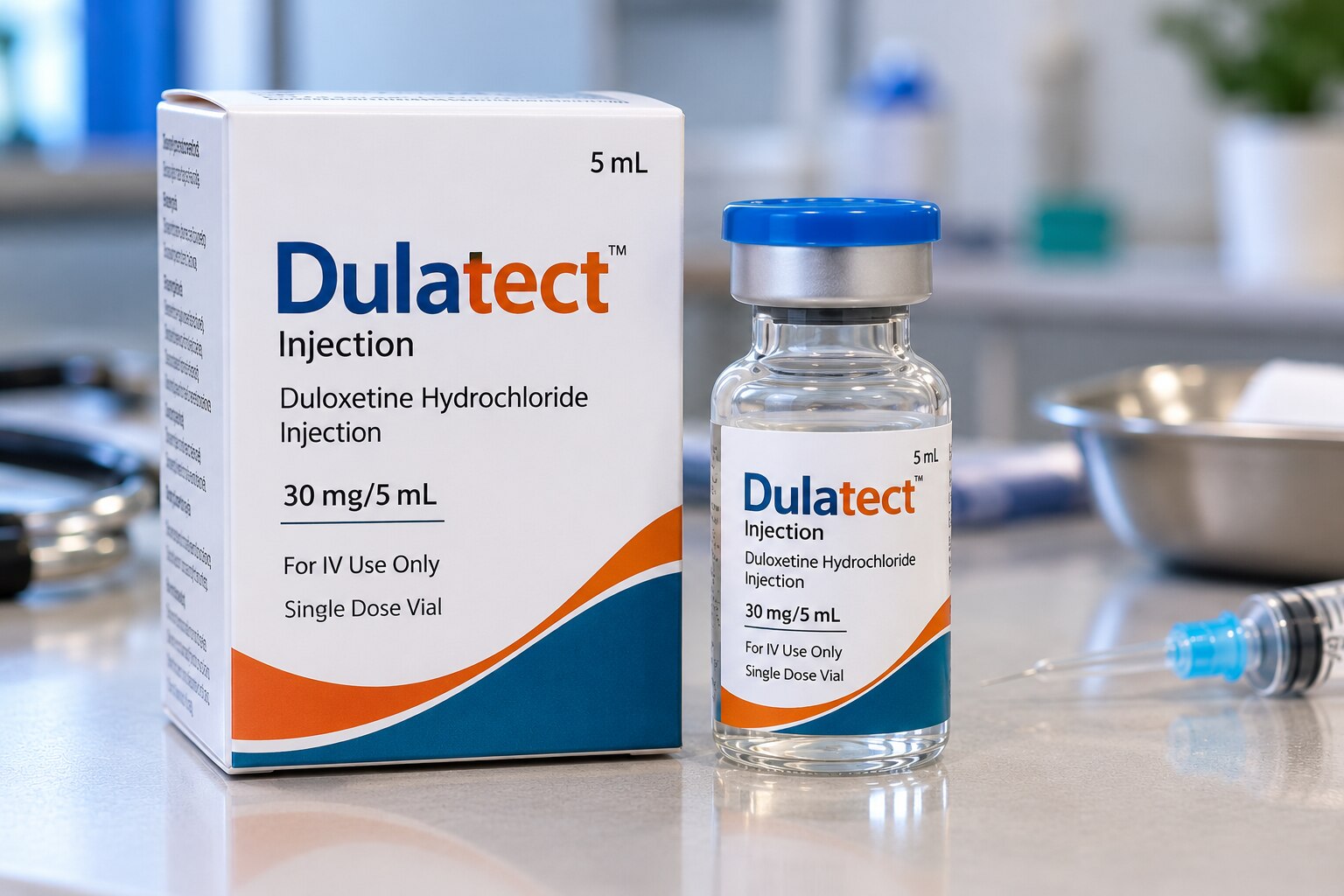
A Dulatect carton is not proof of legitimacy: Dulatect is a brand name, not the generic name. Match the carton, vial, batch-specific certificate of analysis, and destination-country medicines-register entry for anidulafungin, the stated strength, lyophilized injection dosage form, registration number, and labelled manufacturer.
At receipt, reject or quarantine stock with broken seals, damaged cartons, cracked vials, missing dates, unreadable codes, or storage evidence outside the approved limits.
- Confirm the vial and carton show anidulafungin, strength, batch or lot number, manufacturing date, expiry date, manufacturer name, storage statement, and a tamper-evident seal.
- Check the package insert, serialization or traceability code where the market requires it, and concordance between vial, carton, and shipping documents.
- Request the current approved product label, exact-batch certificate of analysis, manufacturing licence, sterile GMP evidence, sterility and bacterial-endotoxin release results, container-closure information, stability data, batch-release records, and pharmacovigilance contact details.
- For imports, request a certificate of pharmaceutical product, free-sale or export documents, legalized licences, local-language packaging, and temperature-excursion records when applicable.
| Document role | What to verify |
|---|---|
| Dulatect manufacturer marketer | The carton, product information, manufacturing licence, and marketing-authorisation record may name different legal entities. |
| Legal manufacturer | Identify the sterile-filling site and licence holder. |
| Marketing-authorisation holder | Confirm approval in the destination medicines register. |
| Distributor or exporter | Confirm authority to supply and responsibility for complaints, recalls, and pharmacovigilance. |
Frequently asked questions
When is anidulafungin the right purchase, and how is the 100 mg vial used?
Anidulafungin is an intravenous echinocandin for candidemia and other invasive Candida infections, plus esophageal candidiasis when the destination label includes that indication. Confirm the adult regimen and presentation before ordering; the 100 mg vial must be prepared and infused according to its package insert.
How does Dulatect compare with caspofungin and micafungin?
All three are echinocandins, but their labelled indications, adult loading and maintenance doses, preparation instructions, infusion requirements, dose adjustments, and storage details differ. Compare the destination-country labels rather than treating the products as interchangeable.
What must the Dulatect package insert say about preparation, infusion, and storage?
Check for named diluents, reconstitution volume, final concentration, infusion duration, handling restrictions, beyond-use time, and storage temperatures for both the vial and prepared solution. Use the approved insert supplied for the destination market.
Which Dulatect buying route fits your volume?
Direct supply suits buyers with recurring volume and the capacity to manage import and quality documentation. A distributor suits smaller or irregular orders. Third-party manufacturing suits buyers that need production under an agreed brand, specification, and regulatory arrangement.
What should you inspect on a Dulatect pack and request from the supplier?
Match the product name, strength, dosage form, batch number, expiry date, manufacturer details, seal, and storage statement against the purchase order. Request the approved package insert, certificate of analysis, batch release documentation, manufacturing licence details, and temperature records when the shipment requires controlled storage.