
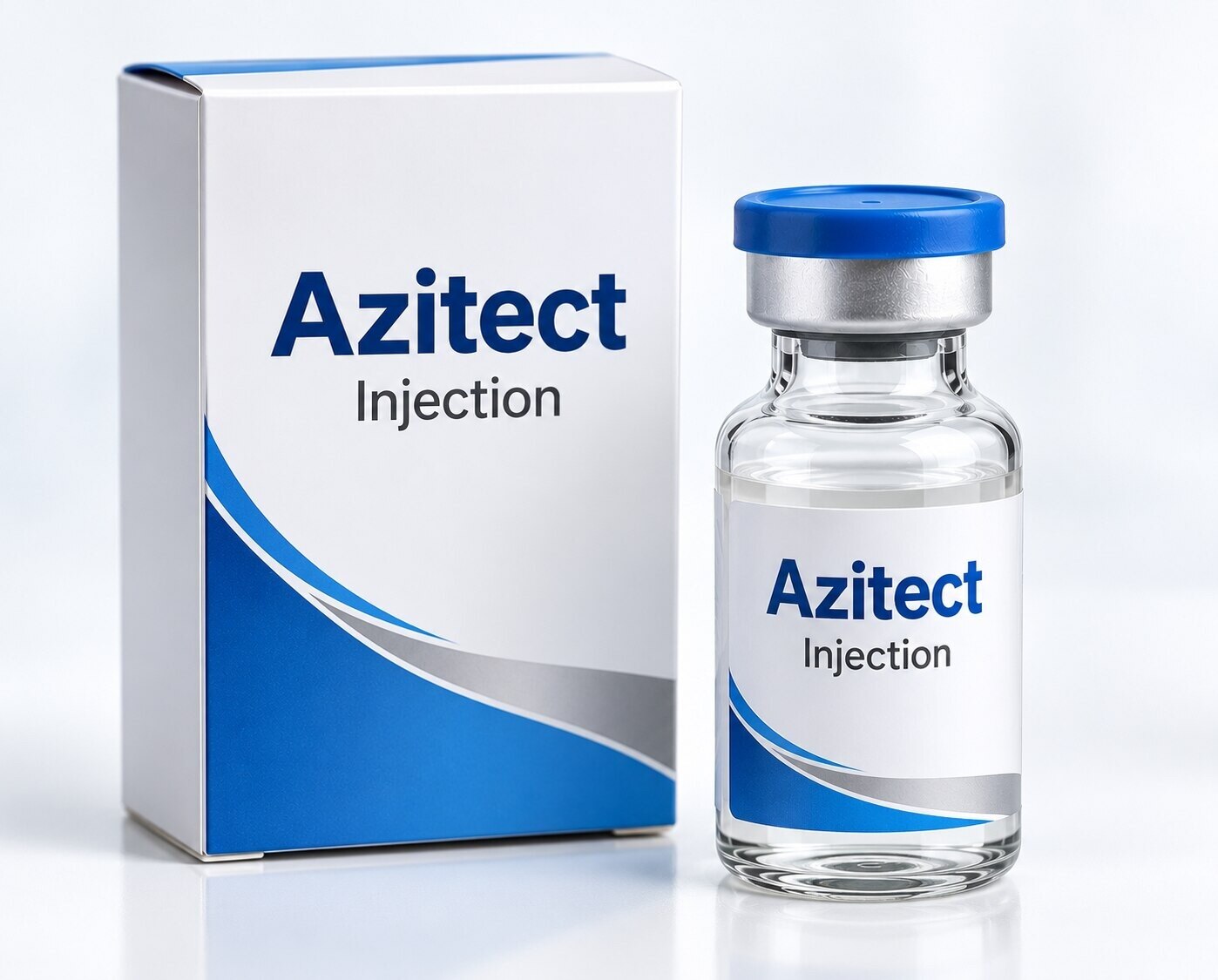
A hospital buyer must first establish whether an Azitect listing refers to azithromycin injection or an aztreonam product, because the two medicines have different antibacterial coverage, administration controls, and procurement documents. By checking the active ingredient, approved label, clinical fit, batch evidence, and supplier controls, you can decide whether the product belongs in your hospital formulary or tender.
Key takeaways
- Request the marketed pack, product information, and recent certificate of analysis.
- Confirm aztreonam strength, vial size, route, and authorised manufacturing site.
- Match aztreonam with the infection, susceptibility results, and hospital antibiotic protocol.
- Compare suppliers through licences, batch records, storage controls, and complaint procedures.
Confirm what Azitect contains before comparing suppliers
A brand name does not identify an antibiotic. Before comparing an azitect for critical care injection company in pune, obtain the marketed pack, approved product information, and a recent batch certificate of analysis. Confirm the active ingredient, strength, dosage form, route, vial size, marketing authorisation holder, and manufacturing site.
1. Read the composition line. “Azithromycin” identifies a macrolide; “aztreonam” identifies a separate monobactam. If the ingredient is cefepime, ceftazidime, or another molecule, record it as a different product.
2. Check the strength and form together, such as azithromycin 500 mg powder for solution for intravenous infusion or aztreonam 1 g powder for injection. Do not accept a catalogue entry that gives only “Azitect.”
3. Match the pack to the approved label. Confirm vial presentation, solvent or reconstitution instructions, dilution fluid, final concentration, storage temperature, shelf life, and administration route.
4. For azithromycin injection, verify that the instructions prohibit intravenous bolus administration and specify dilution to 1–2 mg/mL with infusion over at least 60 minutes at 2 mg/mL or at least 3 hours at 1 mg/mL.
5. Reconcile the batch number, expiry date, certificate of analysis, licence details, and manufacturer address. “Supplied from Pune” does not prove sterile manufacture in Pune.
If the seller cannot provide these documents, pause the comparison. A familiar-sounding name is not evidence that the vial contains azithromycin or aztreonam.
Match the active ingredient to the infection and hospital protocol
Aztreonam injection for hospitals fits suspected or confirmed aerobic Gram-negative infection when culture results, the local antibiogram, and the patient’s allergy history support it. Clinicians may select it for a patient with severe beta-lactam allergy, but aztreonam provides little or no useful coverage for Gram-positive organisms or anaerobes.
A mixed intra-abdominal, skin, or hospital-acquired infection can therefore need a separate agent.
Azithromycin injection is not an interchangeable substitute. It serves different indications and requires a different safety review: assess QT prolongation, torsades history, bradyarrhythmia, uncompensated heart failure, low potassium or magnesium, and concurrent QT-prolonging medicines.
Its IV solution is not given as a bolus; dilute it to 1–2 mg/mL and infuse over at least 60 minutes at 2 mg/mL or at least 3 hours at 1 mg/mL.
Before approving either product, tie the antibiotic to the hospital protocol:
- Match the suspected infection, organisms, culture results, and local antibiogram before selecting aztreonam.
- Add Gram-positive or anaerobic coverage when the syndrome requires it; choose cefepime, piperacillin-tazobactam, a carbapenem, or another approved regimen only under the institution’s protocol.
- Record azithromycin’s formulary approval, restriction criteria, and stewardship review because WHO places it in the Watch group.
- For aztreonam, obtain the approved solvent, reconstitution volume, final concentration, infusion route, in-use stability, particulate-inspection instructions, and compatibility data. Vial strength alone cannot establish safe preparation.
Check the label before approving preparation and administration
Approval should wait until the pharmacy team matches the physical vial to the approved prescribing information. Confirm the generic name, strength, dosage form, vial size, route, storage temperature, expiry, and lot number; a familiar brand name cannot establish preparation instructions.
Obtain these label and dossier details in writing:
- The exact reconstitution solvent, volume, resulting concentration, dilution fluid, final concentration, and permitted administration route.
- In-use stability after reconstitution and dilution, including storage temperature, maximum hold time, and protection from light.
- Infusion duration, whether IV bolus is prohibited, line compatibility, and any required flushing procedure.
- Particulate and colour limits, visual-inspection instructions, container-integrity checks, and instructions for discarding unused solution.
- Contraindications, renal or hepatic warnings, hypersensitivity precautions, interaction warnings, and the manufacturer’s pharmacovigilance contact.
| Product | Administration check | Safety check |
|---|---|---|
| Aztreonam injection | Verify the named solvent, reconstitution volume, final concentration, dilution, compatible fluids, infusion route, and in-use expiry from the approved label. | Do not treat it as automatically safe in penicillin allergy; check beta-lactam history and ceftazidime cross-reactivity because of the shared side chain. |
| Azithromycin injection | Confirm dilution to 1–2 mg/mL; 2 mg/mL requires infusion over at least 60 minutes, while 1 mg/mL requires at least 3 hours. Never approve IV bolus administration. | Review hepatic warnings, including cholestatic hepatitis, interactions, and adverse-event reporting instructions before release. |
Compare Azitect with alternative critical-care antibiotics
Compare the active ingredient, spectrum, resistance data, safety profile, and administration burden—not the Azitect name alone. An aztreonam injection supplier in Pune is not offering an interchangeable substitute for azithromycin injection, cefepime, or piperacillin-tazobactam.
| Option | Coverage and role | Buyer’s decision point |
|---|---|---|
| Aztreonam | Aerobic Gram-negative organisms; little or no useful Gram-positive or anaerobic activity | Consider for selected Gram-negative infections, including some severe beta-lactam allergy cases; add coverage only under the hospital protocol |
| Azithromycin | Macrolide activity, including selected respiratory and atypical pathogens | Do not use as broad sepsis cover; review hepatic warnings, cholestatic hepatitis risk, and pharmacovigilance contacts |
| Cefepime | Broad Gram-negative activity, including Pseudomonas, with better Gram-positive activity than ceftazidime | Compare local susceptibility, renal dosing, and neurotoxicity controls |
| Ceftazidime | Strong Gram-negative and Pseudomonas activity; weak Gram-positive coverage | Avoid treating it as a complete empiric regimen when Gram-positive coverage is needed |
| Piperacillin-tazobactam | Gram-positive, Gram-negative, and anaerobic coverage | Compare allergy, renal-adjustment, infusion, and local resistance requirements |
| Carbapenems | Very broad coverage, with agent-specific differences | Reserve according to stewardship policy and carbapenem-resistance risk |
| Combination injections | Coverage depends on each active ingredient and its dose | Check duplication, compatibility, dilution, and whether the combination matches the antibiogram |
Ask for the hospital’s empiric protocol and antibiogram before selecting. For azithromycin injection, confirm IV dilution and infusion instructions; for every option, match the vial strength, renal or hepatic warnings, and approved indication to the order.
Use a document-led checklist for a Pune injection supplier
Request a document pack before approving any critical care injection company in Pune; a catalogue or local office address does not prove sterile-manufacturing capability or product suitability.
1. Ask for the product licence, manufacturing-site address, GMP evidence, and the licence holder’s name. Reconcile these with the vial label and batch documents. “Manufactured in Pune,” “supplied from Pune,” and “exported by a Pune-based business” are different claims.
2. Request the product dossier for Azitect or aztreonam: active ingredient, strength, dosage form, vial presentation, approved route, reconstitution solvent and volume, dilution, infusion time, in-use stability, storage temperature, expiry period, particulate limits, visual inspection instructions, and compatibility data. Never infer these details from a generic name or vial strength.
3. Obtain three recent commercial-batch records: the certificate of analysis, sterility and bacterial endotoxin results, and approved stability or expiry support. Ask for lot-level traceability from raw materials through batch release.
4. Review sterile-process evidence covering environmental monitoring, aseptic-process simulation or media-fill qualification, container-closure integrity, particulate control, sterility testing, and deviation and CAPA records. Missing records are a qualification issue, not an administrative gap.
5. Confirm the supplier’s dispatch conditions, minimum order quantity, remaining shelf life, temperature-monitoring records, and replacement policy for transit or temperature damage. Protect Life Sciences Pvt ltd. should be assessed against these same documents rather than its catalogue breadth.
6. Before ordering, have pharmacy and infectious-disease teams verify the approved label: azithromycin IV is diluted to 1–2 mg/mL and infused, not given as an IV bolus. For aztreonam, confirm local susceptibility support and any separate Gram-positive or anaerobic coverage.
Frequently asked questions
What should you confirm before comparing Azitect suppliers?
Confirm the active ingredient, strength, dosage form, route, vial size, marketing authorisation holder, manufacturing site, marketed pack, approved product information, and a recent certificate of analysis.
How should hospitals match aztreonam injection to an infection?
Review the suspected or confirmed pathogen, culture and susceptibility results, infection site, renal function, allergy history, and the hospital antibiotic protocol before approval.
Which label details must you check before preparation and administration?
Check the generic name, strength, route, vial size, batch number, expiry date, storage conditions, reconstitution instructions, dilution instructions, and warnings against the approved product information.
How can buyers compare an aztreonam injection supplier in Pune?
Compare the supplier’s licence documents, manufacturing and batch records, certificate of analysis, cold-chain or storage controls, delivery traceability, recall process, and ability to answer technical queries.