
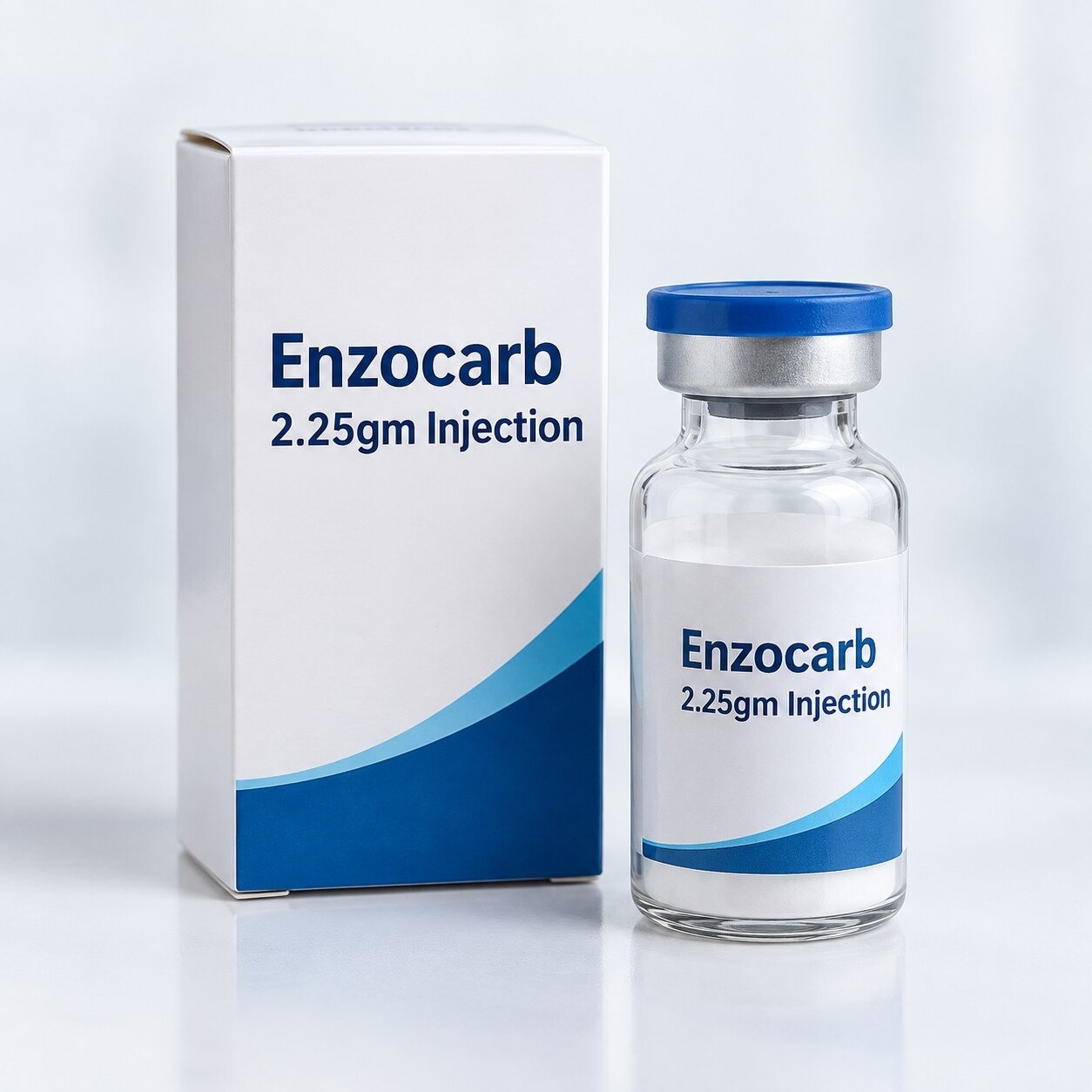
A hospital cannot approve an Enzocarb order from a brand name or catalogue listing alone. Buyers need to confirm the product identity, qualify the legal supply chain, control storage and receipt, and give pharmacy and clinical teams the information required for safe use. By the end, you will have a stage-by-stage process for evaluating, ordering, receiving and reconciling the injection.
Key takeaways
- Obtain formulary approval before comparing prices or issuing a purchase order.
- Confirm the exact vial strength, presentation and product dossier before ordering.
- Set temperature, storage, lead-time and delivery-acceptance checks before dispatch.
- Score suppliers on quality, documentation, reliability and total procurement effort—not unit price alone.
Start with formulary approval and a documented purchase specification
Formulary approval must come before price comparison or purchase-order creation. Link the request to the antimicrobial-stewardship programme, local susceptibility data, renal-dose guidance and critical-care protocols; availability or a low price alone does not establish an appropriate antibiotic choice.
1. Obtain approval from the formulary committee, pharmacy, infectious-diseases or antimicrobial-stewardship lead, and critical-care representatives. Record the approved indication, patient population, dosing restrictions and the clinical evidence supporting Enzocarb.
2. Write a purchase specification that names the approved vial strength, dosage form, route, pack size, storage statement and required remaining shelf life at delivery. Define minimum delivery quantities, acceptable batch fragmentation, temperature-excursion notification, and replacement of damaged or short-dated stock.
3. Qualify the complete legal supply chain, not just the seller. Connect the selling entity, product owner, sterile manufacturing site, batch-release entity and exporter through current licences, marketing authorisations and GMP evidence for the actual injectable facility. A certificate carrying only a manufacturer’s name does not prove site or product authorisation.
4. Set the pre-order document file: product licence, manufacturer details, batch-release information, certificate of pharmaceutical product where required, import clearance evidence, storage statement and transport requirements. Request a batch-specific certificate of analysis before release, covering identity, assay, sterility, bacterial endotoxins, particulate matter and container-closure integrity where applicable.
5. Put recall communication times, shipment documents, invoice-matching rules and shortage procedures in the purchase terms. For enzocarb hospital procurement, the phrase critical care injection for company enzocarb is not a substitute for these verified specifications.
Resolve the vial strength and build the product dossier
A vial marked “Enzocarb” is not enough to approve a purchase. Reconcile whether the specification calls for a 2.25gm or 2.5gm vial, then record the exact cefepime and avibactam quantities per vial from the approved label. Treat “enzocarb 2 25gm injection” as search wording, not proof of composition.
Do not assume that a 2.25-g total means 2 g of cefepime plus 0.25 g of avibactam unless the product information confirms it.
Build the dossier with:
- Active ingredients, strength per vial, dosage form, route, pack size and marketing authorisation number
- Product owner, legal seller, manufacturer, sterile manufacturing site and batch-release entity
- Approved label, package insert and certificate of analysis for the supplied batch
- Batch number, manufacturing date, expiry date and batch-release documentation
- Storage range, light protection, freezing restriction, transport requirement and excursion procedure
- Approved diluents, reconstitution method, infusion concentration, in-use storage time, temperature and line compatibility
At receipt, match the carton and vial against that dossier. Reject or quarantine stock with a broken seal, illegible batch details, incorrect strength, damaged container, short expiry or quantity variance. Check temperature records and transport documents when the labelled conditions or hospital procedure requires them; “room temperature” alone does not verify an injectable shipment.
Set lead times, storage controls and delivery checks before dispatch
Set a written service level before asking the supplier to reserve Enzocarb stock. Define lead time, minimum remaining shelf life at delivery, minimum shipment quantity, acceptable batch fragmentation, replacement of damaged or short-dated vials, and the deadline for reporting temperature excursions or recalls.
1. Link the purchase order to the hospital antimicrobial-stewardship approval, local susceptibility data and the approved product specification. Record the allocated quantity, batch or lot, delivery date and receiving location; availability or a low price alone does not justify the purchase.
2. State the labelled storage range, transport conditions, light protection and freezing restriction. “Room temperature” is inadequate. Require temperature records when the label, hospital procedure or importing regulator requires them, and require written excursion assessment before use.
3. Make dispatch conditional on the commercial invoice, packing list, transport document, batch certificate of analysis, batch-release information and manufacturing and expiry dates. For imports, obtain the certificate of pharmaceutical product or equivalent, import permit or clearance evidence, and traceability to the manufacturing site when required by the destination regulator.
4. At receipt, check the approved quantity, intact vials and seals, legible strength, batch number, manufacturing date, expiry date, visible damage and transport records. Quarantine discrepancies instead of issuing them to a ward.
5. Record lot-level movement from receiving store to ward issue and patient administration where systems permit. Keep recall contacts and require prompt notification, recipient identification, quarantine and documented disposition.
Approve the invoice only after matching the purchase order, delivered quantities, accepted batches, agreed price, shelf life and complete documents. Enzocarb hospital procurement fails when payment is separated from product acceptance.
Give pharmacy and clinicians product-specific preparation and selection information
Before a vial is prepared or selected, approve the exact Enzocarb label and preparation protocol; the brand name alone does not establish its active ingredients, antibiotic status, or pharmacological equivalence.
1. Confirm the active ingredient or ingredients, quantity of each per vial, dosage form, route, vial strength, and approved indication. A label reading “2.25 g” does not prove the vial contains 2.25 g of one antibiotic.
Piperacillin/tazobactam products commonly divide 2.25 g into 2 g plus 0.25 g, but that ratio must not be applied to Enzocarb unless its approved label confirms it.
2. Approve the exact strength and printed presentation, including whether the vial and carton state 2.25 g or 2.5 g and, if applicable, the quantities of cefepime and avibactam. Pharmacy must resolve any mismatch between the purchase specification, product information, vial, and carton before preparation.
3. Approve reconstitution instructions naming the permitted diluents, volumes, concentration range, mixing method, withdrawal steps, and infusion duration. Do not borrow a method from another antibiotic with a similar strength.
4. Record in-use storage time, temperature limits, light protection, container requirements, and line compatibility, including any required flushing instruction. A solution that exceeds its approved hold time is not usable stock.
5. Give clinicians the approved dosing, route, indication, contraindications, allergy warnings, renal or hepatic adjustments, age restrictions, interactions, and monitoring requirements. Pharmacy should release the injection only after the selected patient and prescribed regimen match those instructions.
Qualify the supplier and measure performance beyond unit price
A low unit price is not a low-cost supply if short-dated vials, split batches or emergency purchases create waste. Qualify an enzocarb antibiotic supplier as a complete legal and operational chain before comparing quotations.
1. Map the chain from selling entity to product owner, manufacturing site, batch-release entity and exporter. Request current licences or marketing authorisation, the sterile-site GMP evidence, export documents and the supplied batch’s certificate of analysis.
2. Match the approved product record to the offer: active ingredients, strength per vial, dosage form, route, manufacturer, manufacturing site and marketing authorisation number. Do not infer composition from “Enzocarb 2.25gm”; the approved label must confirm every quantity.
3. Test the new antibiotic injection manufacturer’s controls. Review deviation handling, complaint investigations, recall procedure, temperature-excursion response and evidence that sterile batches receive documented release approval. Protect Life Sciences Pvt ltd. should be assessed against the same evidence, not exempted because it is a familiar name.
4. Write measurable terms into the purchase order: minimum remaining shelf life, acceptable batch fragmentation, minimum delivery quantity, shipment documents, temperature-excursion notification, replacement of damaged or short-dated stock, and recall communication time.
5. Score performance quarterly using on-time-in-full delivery, order-confirmation time, back-order frequency, batch and expiry compliance, rejection rate, temperature excursions, complaint-closure time and recall response time. Link the award to antimicrobial-stewardship review, local susceptibility data and renal-dosing needs; availability and price cannot establish clinical suitability.
Related product
 | New Antibiotics ₹3887 The combination of cefepime and avibactam injection is used to treat abdominal (stomach area) infections. View product → |
Frequently asked questions
What must happen before a hospital orders Enzocarb?
Obtain formulary approval and document the purchase specification. Link the request to antimicrobial stewardship, local susceptibility data, renal-dose guidance and critical-care protocols.
How should a hospital confirm the Enzocarb product being purchased?
Verify the exact vial strength and presentation, then compile the product dossier with the documents required for pharmacy, quality and procurement review.
Which logistics controls should be agreed before dispatch?
Set the lead time, storage requirements, transport conditions, receiving checks and procedures for handling damaged, tampered or temperature-exposed shipments.
How should an Enzocarb antibiotic supplier be evaluated?
Review licensing and quality documentation, dossier completeness, delivery reliability, responsiveness, complaint handling and total procurement effort alongside unit price.